The short answer
Overall pick? Anker SOLIX C1000 Gen 2
Big loads or more battery later? DJI Power 1000 V2
Both hold 1,024Wh of LFP and switch over in about 10 ms. The C1000 Gen 2 wins 5 spec rows to 2: faster AC charging, more USB-C ports, a built-in 12V car socket, and a lighter, smaller box. The DJI wins on continuous output (2,600W against 2,000W) and is the only one you can expand.
Best all-rounder
Pick the Anker SOLIX C1000 Gen 2 if
Full Anker SOLIX C1000 Gen 2 review
- You want built-in solar: 600W with no adapter.
- You want it lighter and smaller: 24.9 lb against about 31.3 lb.
- You use a 12V car socket or more USB-C: 3 ports (15W, 140W, 140W).
Sold by AnkerDirect. Non-returnable on Amazon (hazmat). Pick the plain "C1000 Gen2" style, not a panel, alternator or 2-pack bundle.
Best for big loads and expansion
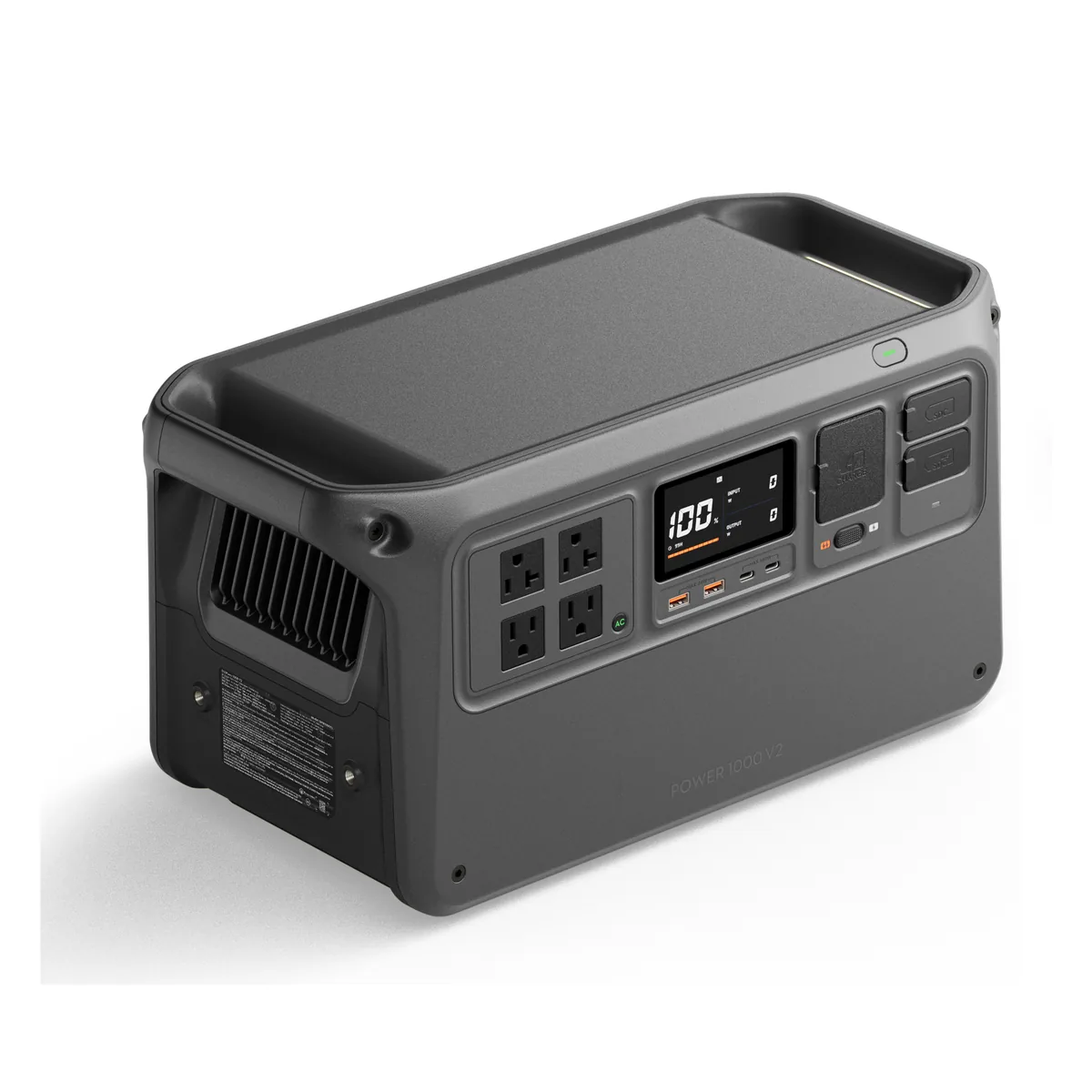
Pick the DJI Power 1000 V2 if
- You run bigger loads: 2,600W continuous.
- You may add batteries later: up to 5 expansion batteries, 11,264Wh total.
- You want fast vehicle charging and will buy DJI's 1kW car charger (up to 1,000W).
Seller check: when we looked, Amazon's listing was sold by Fly Image Tech, a third-party seller, not DJI. Check the seller, condition and return terms before you buy.
Before you buy: the DJI has no built-in solar port and no 12V car socket. Solar (up to 1,800W) and fast car charging (up to 1,000W) need DJI accessories sold separately. The Anker's 1,600W UltraFast charging is switched on in the app and needs the cells above 68°F.
As an Amazon Associate I earn from qualifying purchases.
Key specs
spec rows won
spec rows won
unclear
A green check means one figure is clearly better: more than 5% apart. No check means it's within 5%, tied, measured differently, sources disagree, or Unknown. Maker figures throughout; anything marked (Amazon only) comes from the Amazon listing.
| Anker SOLIX C1000 Gen 2 | DJI Power 1000 V2 | |
|---|---|---|
| Capacity | 1,024Wh, LiFePO4 | 1,024Wh, LFP |
| Continuous AC | 2,000W | 2,600W |
| Surge | 3,000W peak | Unknown |
| AC charging | 1,600W UltraFast: 100% in 49 min; 1,200W standard | Up to 1,440W (battery at 60%+, 68–95°F); full in 56 min |
| Solar input | 600W built in, 11-60V; full in 1.8 h | No built-in port. Up to 1,800W with DJI charger, or 400W with adapter (sold separately); time Unknown |
| Car charging | Supported; rate Unknown | Up to 1,000W with DJI 1kW car charger (sold separately); time Unknown |
| AC and solar together | Yes, solar first | Yes, solar first |
| Outlets | 10 ports per Anker; Amazon says 9 (sources disagree). 5 AC (worked out from Anker's port list), 1 USB-A | 4 AC, 2 USB-A 24W, SDC and SDC Lite ports |
| USB-C | 3: 15W, 140W, 140W | 2: 140W each |
| 12V car socket | Yes, 120W | No |
| UPS switchover | Under 10 ms | 10 ms |
| Weight | 24.9 lb | About 31.3 lb |
| Size | 15.12 × 8.19 × 9.61 in | About 17.6 × 8.9 × 9.1 in |
| Cycle life | 4,000 to 80% | 4,000 to 80% |
| Warranty | 5 years (Amazon only) | Up to 5 years (DJI pages disagree) |
| Expansion | None | Up to 5 batteries, 11,264Wh total |
| App | Anker app | DJI Home app, Wi-Fi and Bluetooth |
| Standby draw | Unknown | Unknown |
| Noise | 20 dB (conditions not stated) | 26 dB at 1 m while charging |
| Operating temps | Discharge -4 to 104°F | Discharge 14 to 113°F |
What it can run
- YES under the AC watts
- TIGHT within 10% of the AC watts
- NO over the AC watts
| Load | Anker SOLIX C1000 Gen 2 (1,024Wh, 2,000W) | DJI Power 1000 V2 (1,024Wh, 2,600W) |
|---|---|---|
| Laptop, 60W | YES About 10.0 to 11.4 hours. | YES About 10.0 to 11.4 hours. |
| CPAP, 40W | YES About 13.5 to 16.0 hours. | YES About 13.5 to 16.0 hours. |
| Router and modem, 20W | YES About 20.6 to 27.0 hours. | YES About 20.6 to 27.0 hours. |
| Fridge, 80W average | YES About 8.0 to 8.8 hours. | YES About 8.0 to 8.8 hours. |
| Full-size fridge, 150W average | YES About 4.7 to 4.9 hours. | YES About 4.7 to 4.9 hours. |
| Coffee maker, 1000W | YES About 0.8 hours. | YES About 0.8 hours. |
| Space heater, 1500W | YES About 0.5 hours. | YES About 0.5 hours. |
| Hair dryer, 1800W | TIGHT About 0.4 hours. | YES About 0.4 hours. |
| Kettle, 1900W | TIGHT About 0.4 hours. | YES About 0.4 hours. |
Hours = capacity × 0.85 × 0.90 ÷ (load + standby draw). Estimates, not a test. Neither maker publishes a standby draw, so both ranges use 9 to 18W.
Skip it if
Skip the Anker SOLIX C1000 Gen 2
if you need more than 2,000W or want to add batteries later. It can't expand.
Skip the DJI Power 1000 V2
if you want to plug solar panels or a 12V device straight in without buying DJI accessories.
Before you buy
- DJI Power 1000 V2: solar and fast car charging go through the SDC port and need DJI accessories sold separately. There's no built-in 12V car socket.
- DJI Power 1000 V2: the 1,440W grid charge needs the battery at 60% or more and 68–95°F.
- DJI Power 1000 V2: when we checked, Amazon's seller was Fly Image Tech (third party, not DJI). Check the seller and return terms.
- C1000 Gen 2: sold by AnkerDirect and non-returnable on Amazon (hazmat). UltraFast 1,600W charging is switched on in the Anker app and needs the cells above 68°F.
Where the sources disagree
- DJI warranty: one DJI page says 5 years standard; another says 3 years plus 2 more after you connect the DJI Home app. This page says "up to 5 years."
- C1000 Gen 2 outlets: Anker says 10 ports; Amazon's field says 9 outlets. Anker doesn't state an AC count; 5 is worked out from its port list.
- Noise is measured differently (DJI at 1 m while charging, Anker conditions not stated), so no check is given.
Still Unknown
- DJI surge watts, standby draw, and solar and car charge times.
- C1000 Gen 2 car charging rate and standby draw.
- C1000 Gen 2 warranty on Anker's page (Amazon says 5 years).
As an Amazon Associate I earn from qualifying purchases.
By Mike E. · Last checked October 20, 2026 · Based on maker spec pages, manuals and Amazon listings where marked. Not tested hands-on.
Questions about this pair
Which one runs longer?
Neither on its own: both hold 1,024Wh. Only the DJI can add batteries, up to 11,264Wh total.
Which handles bigger loads?
The DJI: 2,600W continuous against 2,000W. DJI publishes no surge figure.
Can I plug either into solar panels directly?
The Anker has a built-in 600W solar input. The DJI has no built-in solar port; it needs a DJI adapter or charger sold separately.
Which is better as a UPS?
They're about even: Anker says under 10 ms, DJI says 10 ms.
Related comparisons
- Anker SOLIX C1000 Gen 2 vs Jackery Explorer 1000 v2
- Anker SOLIX C1000 Gen 2 vs Bluetti Elite 100 V2
- Anker SOLIX C1000 Gen 2 vs EcoFlow DELTA 3
All power station matchups: hadtopick comparisons