The short answer
Overall pick? EcoFlow DELTA Pro 3
Need more AC watts or solar? Anker SOLIX F3800 Plus
The DELTA Pro 3 wins 5 spec rows to 4. It holds more (4096Wh against 3840Wh), switches over in 10 ms, is rated for more cycles, has more 12V DC output and is about 23 lb lighter. The F3800 Plus is the pick if you want raw output and solar: 6000W against 4000W, 3200W of solar input against 2600W, six 120V 20A outlets and much bigger expansion.
Best for more AC watts, solar and expansion
Pick the Anker SOLIX F3800 Plus if
- You need more output: 6000W continuous at 120V/240V.
- You charge from solar: 3200W total, two 1600W inputs up to 165V.
- You may grow it: up to 6 expansion batteries, 26.9kWh per unit, and it can charge from a 240V or 120V generator.
Best for more capacity and a faster UPS
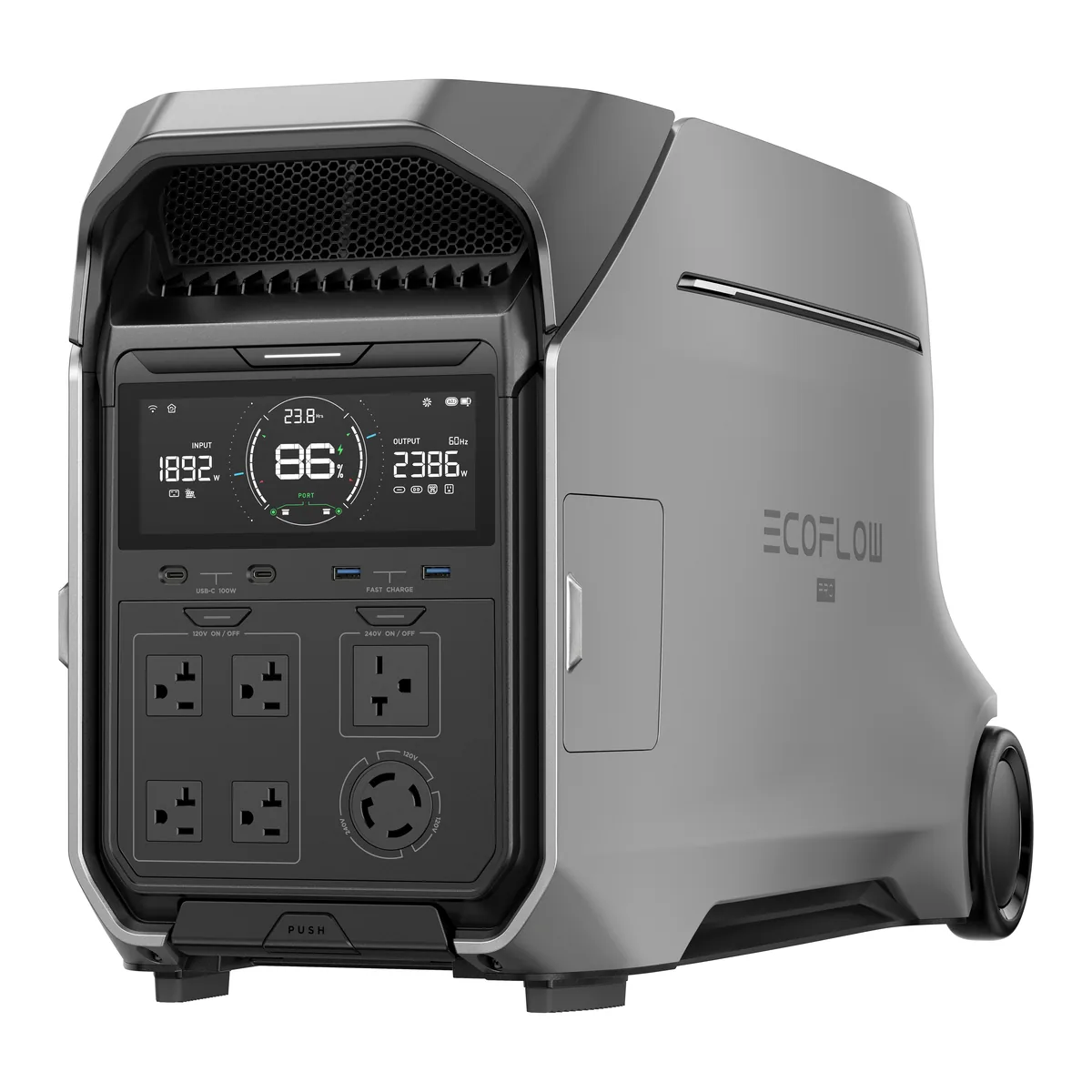
Pick the EcoFlow DELTA Pro 3 if
Full EcoFlow DELTA Pro 3 review
- You want the bigger battery: 4096Wh against 3840Wh.
- You want a fast UPS (10 ms) and 4000 cycles to 80%.
- You want the lighter unit: 113.54 lb against 136.7 lb.
As an Amazon Associate I earn from qualifying purchases.
Key specs
spec rows won
spec rows won
unclear
A green check means one figure is clearly better: more than 5% apart. No check means it's within 5%, tied, measured differently, or Unknown. Maker figures throughout; anything marked (Amazon only) comes from the Amazon listing.
| Anker SOLIX F3800 Plus | EcoFlow DELTA Pro 3 | |
|---|---|---|
| Capacity | 3840Wh, LFP | 4096Wh, LFP |
| Continuous AC | 6000W, 120V and 240V | 4000W, 120/240V |
| Surge | Unknown | 8000W (X-Boost 6000W) |
| AC charging | 1800W max at 120V; time Unknown. 240V via Home Power Panel port and Generator Input Adapter: 3300W, 6000W with an expansion battery | 0-80% in 50 min (EcoFlow doesn't state the input); US wall port 120V 2000W per EcoFlow's FAQ; up to 7000W combining sources |
| Solar input | 3200W total: 2 ports, 11-165V, 1600W each | 2600W total: High-PV 30-150V 1600W + Low-PV 11-60V 1000W |
| Car charging input | Unknown | 12V 8A / 48V 20A; 800W Alternator Charger compatible |
| AC + solar together | Unknown | Yes, up to 7000W combined |
| 120V 20A outlets | 6 × NEMA 5-20R | 4 × NEMA 5-20R |
| 30A outlets | 1 × TT-30R (120V, 3000W), 1 × L14-30R (120/240V, 6000W) | 1 × TT-30R, 1 × L14-30R, plus 1 × NEMA 6-20R (240V) |
| USB | USB-A 12W, USB-C 100W per port; counts Unknown | 2 USB-A 18W, 2 USB-C 100W |
| 12V DC output | 12V 10A car output | 378W total: DC5521 and Anderson 30A |
| UPS switchover | 20 ms | 10 ms (20 ms through Smart Home Panel 2) |
| Weight | 136.7 lb | 113.54 lb |
| Size | 27.6 × 15.3 × 15.6 in incl. wheels | 16.16 × 13.43 × 27.28 in |
| Cycle life | 3000+ to 80% | 4000 to 80% |
| Warranty | 5 years | 5 years |
| Expansion, battery only | Up to 6 batteries, 26.9kWh per unit; 2 units 53.8kWh | 2 Extra Batteries, 12kWh per unit; 3 units 36kWh |
| EV / RV | Via TT-30P or L14-30; no NEMA 14-50 | Level 1/2 EV via EV X-Stream Adapter, sold separately |
| Noise | Unknown | As low as 30 dB |
| Water resistance | None stated | Battery pack IP65; main unit IP20 |
| Standby draw | Unknown | Unknown |
What it can run
- YES under the AC watts
- TIGHT within 10% of the AC watts
- NO over the AC watts
| Load | Anker SOLIX F3800 Plus (3,840Wh, 6,000W) | EcoFlow DELTA Pro 3 (4,096Wh, 4,000W) |
|---|---|---|
| Phone charges, about 15Wh each | YES About 195 charges. | YES About 208 charges. |
| Laptop, 60W | YES About 49.0 hours. | YES About 52.2 hours. |
| Camp lights, 10W | YES About 293.8 hours. | YES About 313.3 hours. |
| Portable fan, 30W | YES About 97.9 hours. | YES About 104.4 hours. |
| CPAP, 40W | YES About 73.4 hours. | YES About 78.3 hours. |
| 12V cooler, 45W average | YES About 65.3 hours. | YES About 69.6 hours. |
| Fridge, 80W average | YES About 36.7 hours. | YES About 39.2 hours. |
| Coffee maker, 1000W | YES About 2.9 hours. | YES About 3.1 hours. |
| 12V blanket, 50W | YES About 58.8 hours. | YES About 62.7 hours. |
Hours = capacity × 0.85 × 0.90 ÷ load. Estimates, not a test. Standby draw is not published for either unit, so real runtimes on small loads can be shorter.
Skip it if
Skip the Anker SOLIX F3800 Plus
if you want to plug an EV or RV straight into a NEMA 14-50. The Plus has a TT-30R and an L14-30R instead, with no 14-50. Also skip it if you need 240V while charging from 120V AC: Anker says 240V output isn't available then.
Skip the EcoFlow DELTA Pro 3
if you need more than 4000W continuous, or plan to run 120V and 240V outlets at once. EcoFlow says the 120V and 240V outlets aren't used at the same time (a button selects).
Before you buy
- F3800 Plus: there's no NEMA 14-50, so an EV or RV can't plug in directly the way it could on the original F3800. Use the TT-30R or L14-30R.
- F3800 Plus: the six 5-20R outlets are disabled while the Generator Input Adapter is connected, and 240V output isn't available while charging on 120V AC.
- DELTA Pro 3 expansion: with batteries only, the most is 36kWh (3 units with 2 Extra Batteries each). EcoFlow's "up to 48kWh" headline counts Smart Generators, so this page doesn't use it.
- DELTA Pro 3: the main unit is IP20, so it's for indoor or sheltered use. Only the battery pack is IP65.
- DELTA Pro 3: the 120V and 240V outlets aren't used at the same time; split-phase is via the L14-30.
Where the sources disagree
- F3800 Plus solar recharge time: Anker says "under 2 hours" on one page and "within 1.5 hours" on another, in optimal sun.
- F3800 Plus generator charging at 6000W: Anker's US page says 1 or more expansion batteries are needed; its Canada page says 2 or more.
- DELTA Pro 3 weight: EcoFlow says 113.54 lb; Amazon says 115 lb.
- DELTA Pro 3 expansion: 48kWh headline (with Smart Generators) vs 36kWh with batteries only. This page uses 36kWh.
Still Unknown
- Standby draw, for both.
- F3800 Plus surge watts, USB port counts, noise, wall-charge time, AC + solar together and car charging input.
- DELTA Pro 3 solar charge time.
As an Amazon Associate I earn from qualifying purchases.
By Mike E. · Last checked October 20, 2026 · Based on maker spec pages, manuals and Amazon listings where marked. Not tested hands-on.
Questions about this pair
Which runs longer?
The DELTA Pro 3, slightly: 4096Wh against 3840Wh, about 7% more. See the chart above.
Which can run more at once?
The F3800 Plus: 6000W continuous against 4000W, and six 120V 20A outlets against four.
Which takes more solar?
The F3800 Plus: 3200W across two 1600W inputs (up to 165V), against 2600W on the DELTA Pro 3.
What changed from the original F3800?
More solar (3200W against 2400W, with higher-voltage inputs), charging from a 240V or 120V generator, and a TT-30R in place of the NEMA 14-50. It is also a little heavier at 136.7 lb. Capacity, output, UPS speed and expansion are the same.