In one minute
These are portable battery power stations, not gas generators. They store energy in LFP batteries and convert it to AC and DC power for RV use. Official manufacturer product pages, manuals, and support documents are the only sources used here. Specs can vary by region or revision; US-focused details are noted where available. Test-dependent numbers (charge times, real-world solar) follow the manufacturers’ footnotes. Anything not confirmed on an official page is marked UNVERIFIED. No prices or ratings appear.
This is a battery power-station guide, not a gas-generator guide.
As an Amazon Associate I earn from qualifying purchases. The Amazon buttons on this page are affiliate links.
How These Units Differ for RV Use
All three are quiet, exhaust-free battery power stations designed for homes, RVs, and outdoor use. They are not continuous high-output fuel generators. Only one lists a 30 A RV-style outlet.
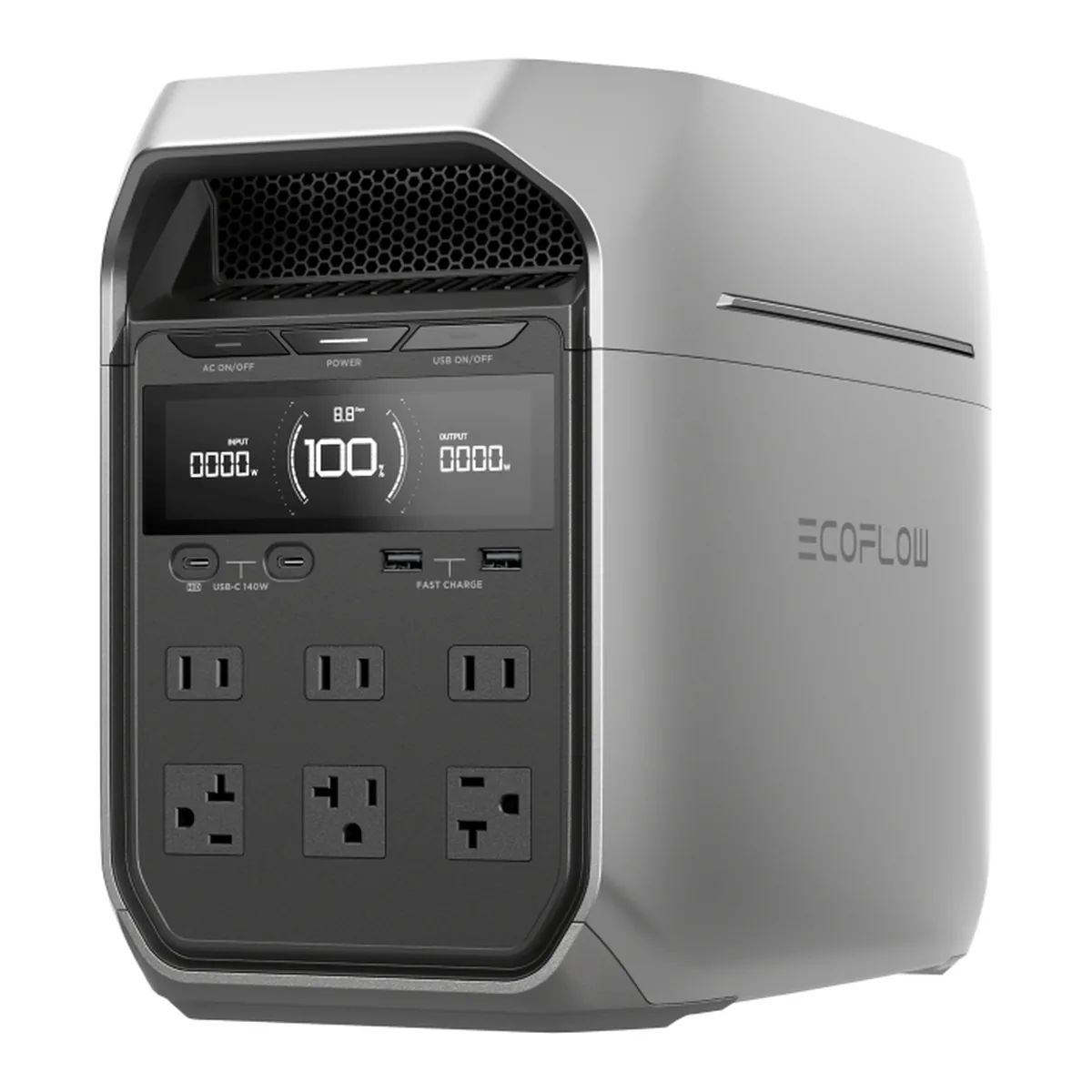
- EcoFlow DELTA 3 Plus is the lightest of the three. It offers 1024 Wh, 1800 W continuous AC output, six standard AC outlets, and dual solar inputs. No TT-30 or 30 A RV receptacle is listed.
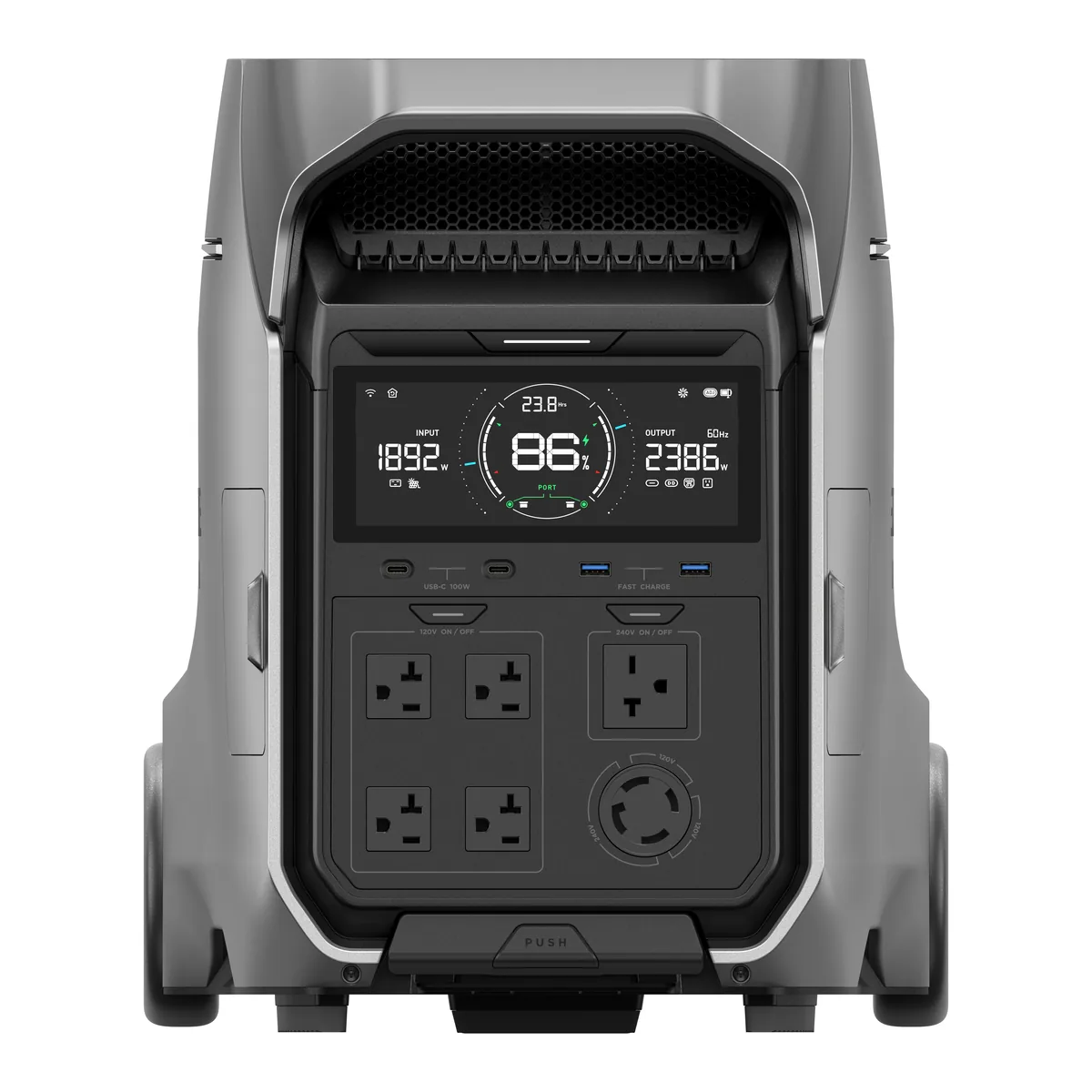
- EcoFlow DELTA Pro 3 is the highest-capacity and highest-output unit. It lists a NEMA TT-30R 30 A outlet and supports 120 V or 240 V output (not at the same time). It is much heavier.
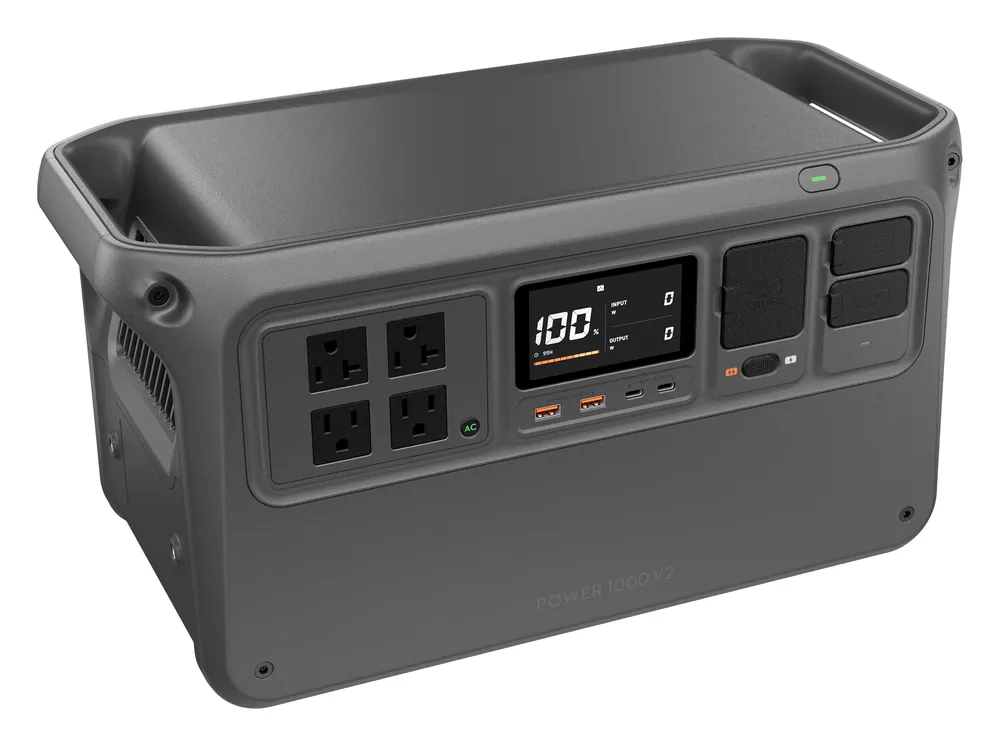
- DJI Power 1000 V2 matches the DELTA 3 Plus on capacity. It has four AC outlets on the US model and strong accessory support for car and solar charging. No TT-30 is listed. Continuous output claims differ between the official spec sheet and product pages (see table).
Key Specs Comparison
| Spec | EcoFlow DELTA 3 Plus | EcoFlow DELTA Pro 3 | DJI Power 1000 V2 |
|---|---|---|---|
| Chemistry & capacity | LFP, 1024 Wh | LFP, 4096 Wh | LFP, 1024 Wh |
| Continuous AC output | 1800 W (surge 3600 W); X-Boost 2200 W | 4000 W (surge 8000 W); X-Boost 6000 W | Spec sheet (US model): max 20 A at 100–120 V. Product pages claim continuous 2600 W until depleted (lab conditions). Exact continuous wattage: UNVERIFIED |
| AC outlets | 6 standard AC (120 V US) | 4 × NEMA 5-20R (20 A), 1 × NEMA TT-30R (30 A), 1 × NEMA L14-30R, 1 × NEMA 6-20R | 4 AC outlets on US model |
| TT-30 / 30 A RV outlet | Not listed | Listed (NEMA TT-30R) | Not listed |
| USB | 2 × USB-C 140 W, 2 × USB-A 36 W | 2 × USB-C 100 W, 2 × USB-A 18 W | 2 × USB-C 140 W, 2 × USB-A 24 W |
| 12 V outputs | Car port 12.6 V / 10 A / 126 W + 2 × DC5521 | 12.6 V / 30 A total (378 W) | SDC / SDC Lite ports (accessory use) |
| AC charge | 1500 W; 0–100% in 56 min | 100–240 V input; 0–80% as fast as 50 min | Full charge in 56 min (fast mode, lab conditions) |
| Solar input | 2 ports, 11–60 V, 500 W max each (1000 W total) | 2600 W total (High-PV 30–150 V / 1600 W; Low-PV 11–60 V / 1000 W) | Via accessories; base-unit continuous window UNVERIFIED |
| Car / alternator input | 12 V 8 A max; optional 800 W alternator charger | 12 V 8 A / 48 V 20 A max | Via official car charger accessories |
| UPS switchover | 10 ms | 10 ms | Claimed 10 ms on product materials |
| Expansion | Up to ~5 kWh with compatible extra batteries | Up to 12 kWh per unit (2 extra batteries) | Up to 5 expansion batteries (claimed 11,264 Wh) |
| Weight | ≈12.5 kg (27.6 lb) | 51.5 kg (113.54 lb) | ≈14.2 kg |
| Dimensions | ≈398 × 202 × 283.6 mm | 410.4 × 341 × 693 mm | 448 × 225 × 230 mm |
| US warranty | 5 years | 5 years (3 standard + 2 with EcoFlow App registration) | 3 years default + 2 years via DJI Home app first connection |
| Model notes | EF-DL-H10-4 | US version with TT-30 | DYM1000V2L (100–120 V) |
Sources for the table are listed at the end. Continuous output, charge times, and solar performance are subject to manufacturer footnotes and test conditions.
Charging and Outlets for RV Travel
AC outlets and RV hookup. The DELTA Pro 3 is the only unit that officially lists a NEMA TT-30R 120 V 30 A outlet. The DELTA 3 Plus and DJI Power 1000 V2 list standard AC outlets only. Do not assume a 30 A RV pedestal connection on units that do not list the TT-30 receptacle. Use the listed outlets for individual appliances within the continuous AC rating.
Vehicle charging. All three support car or alternator charging through official inputs or accessories. DELTA 3 Plus lists a 12 V 8 A car input and an optional 800 W alternator charger. DELTA Pro 3 lists 12 V 8 A / 48 V 20 A. DJI Power 1000 V2 uses its Super Fast Car Charger or Solar/Car Super Fast Charger accessories. Stay within the published current and voltage limits.
Solar. DELTA 3 Plus accepts up to 1000 W total across two 11–60 V ports. DELTA Pro 3 accepts up to 2600 W total across high- and low-voltage ports. DJI solar charging is done through official adapter modules and chargers; the exact continuous input window on the base unit is UNVERIFIED in the core specs.
UPS. All three list fast switchover (10 ms) for sensitive loads when the unit is charged and powered.
Who It’s For
Choose based only on official capacity, continuous output, listed outlets, charging windows, and weight.
- DELTA 3 Plus fits lighter RV loads (fridge, CPAP, devices, lights) where weight matters (~28 lb) and you can recharge via solar or the vehicle. Six standard AC outlets and dual solar inputs are useful. No TT-30 is available.
- DELTA Pro 3 fits higher continuous loads and longer runtime needs. It is the only unit here with an official 30 A TT-30 outlet and 120 V or 240 V output. At roughly 114 lb with wheels, it is better left in place than carried frequently.
- DJI Power 1000 V2 fits similar capacity and weight to the DELTA 3 Plus, with four AC outlets and strong official accessory support for car and solar charging. Confirm the continuous output rating that applies to your 120 V unit before relying on the higher marketing figure.
None of these replaces a gas generator for multi-day high-load use without external charging. Match the continuous AC rating to the measured running watts of your appliances.
FAQ
Does any unit have a TT-30 or 30 A RV receptacle?
Only the EcoFlow DELTA Pro 3 lists a NEMA TT-30R 120 V 30 A outlet. The DELTA 3 Plus and DJI Power 1000 V2 do not.
Can I run a fridge, CPAP, and small devices?
Yes, within the continuous AC rating and remaining capacity. Measure the actual watt draw of your appliances. These units do not claim to replace a full 30 A RV shore-power connection except where the TT-30 is listed.
How do I estimate runtime?
Runtime (hours) ≈ usable capacity (Wh) ÷ average load (W). Use the rated capacity as the starting point. Real usable energy is lower due to inverter losses, temperature, and partial discharge (see manufacturer footnotes). Do not invent appliance wattages—measure them.
What is the official solar input?
DELTA 3 Plus: 11–60 V, 500 W max per port (1000 W total). DELTA Pro 3: up to 2600 W total across two ports. DJI: via official accessories; base-unit continuous window UNVERIFIED.
Is there UPS switchover?
Yes. DELTA 3 Plus lists 10 ms. DELTA Pro 3 lists 10 ms. DJI product materials list 10 ms.
How heavy are they to move in an RV?
DELTA 3 Plus ≈ 27.6 lb. DJI Power 1000 V2 ≈ 31 lb. DELTA Pro 3 ≈ 114 lb (wheels and handle listed).
Can they charge from the tow vehicle?
Yes, via the official car or alternator inputs/accessories listed above. Stay within the published current limits.
Are these gas generators?
No. They are battery power stations. They produce no exhaust and require no fuel. Continuous high-load or multi-day operation without solar, vehicle, or shore charging is limited by battery capacity.
Sources
- EcoFlow DELTA 3 Plus product page: https://us.ecoflow.com/products/delta-3-plus-portable-power-station
- EcoFlow DELTA 3 Plus user manual: https://manuals.ecoflow.com/us/product/delta-3-plus
- EcoFlow DELTA Pro 3 product page: https://us.ecoflow.com/products/delta-pro-3-portable-power-station
- DJI Power 1000 V2 specs: https://www.dji.com/global/support/product/power-1000-v2
- DJI Power 1000 V2 support/FAQ pages (warranty and product claims): https://www.dji.com/global/support/product/power-1000-v2
- EcoFlow US warranty policy (DELTA 3 Plus and DELTA Pro 3): referenced on official EcoFlow US product and support pages