The short answer
Overall pick? EcoFlow DELTA 3 Plus
Most energy in one box? Bluetti AC180
The DELTA 3 Plus leads on paper: double the solar input (1,000W against 500W), a faster wall charge, more ports, and it can add extra batteries up to 5kWh. It’s also about 9 lb lighter. The AC180 holds 128Wh more, so it runs a little longer on one charge, and it has a wireless charging pad. The AC180 can’t add capacity.
Best for the most energy per charge
Pick the Bluetti AC180 if
- You want the bigger battery: 1,152Wh against 1,024Wh.
- You want a 15W wireless charging pad for your phone.
- You’re fine with a fixed size. Bluetti’s FAQ says the AC180 doesn’t support capacity expansion.
Don’t mix it up with the AC180P, a different 1,440Wh model.
Check the AC180 on AmazonBest for solar and growing later
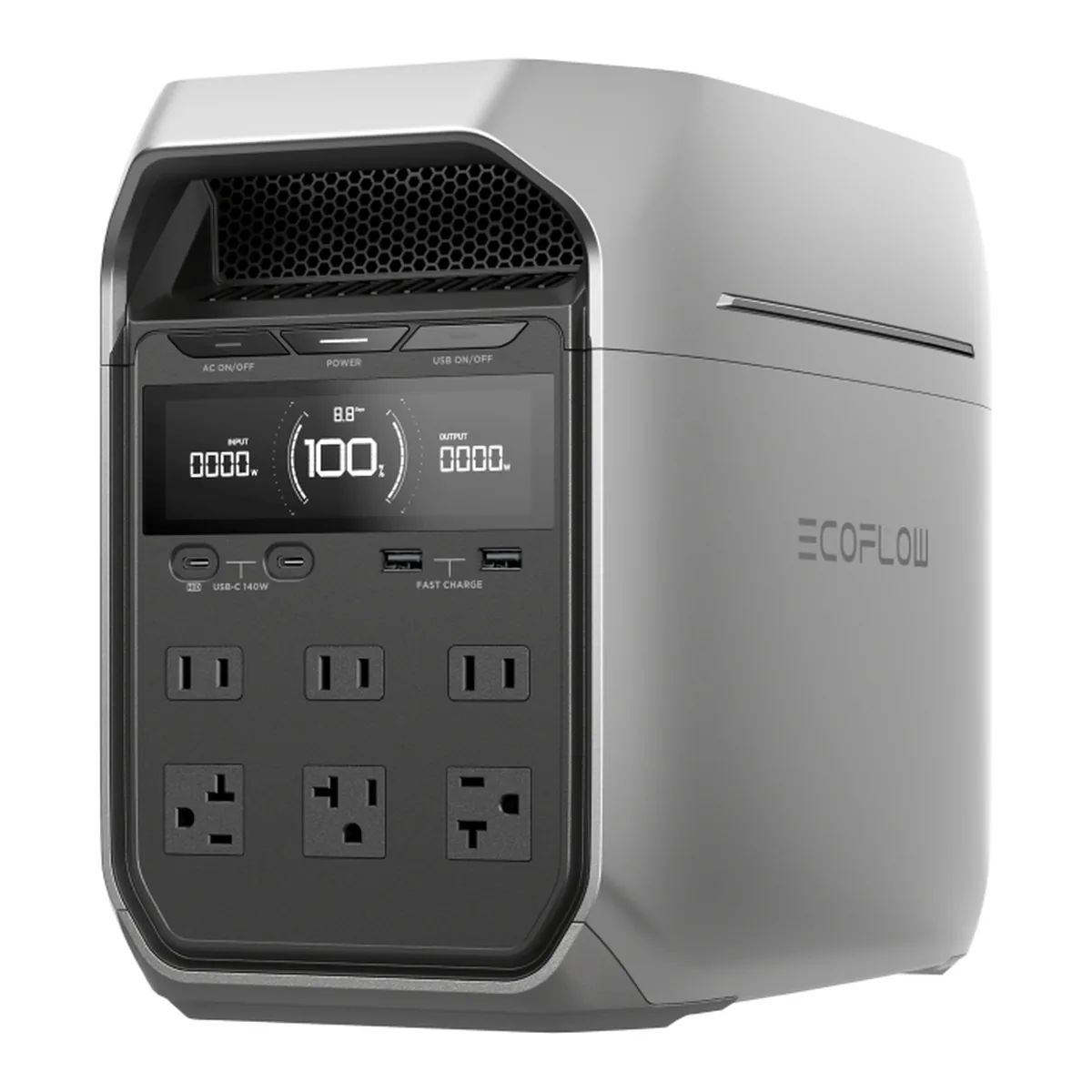
Pick the EcoFlow DELTA 3 Plus if
Full EcoFlow DELTA 3 Plus review
- You charge from solar: two ports, up to 1,000W in total. EcoFlow lists a full charge in 70 minutes at 1,000W.
- You may add capacity later: up to 5kWh with EcoFlow’s extra batteries.
- You carry it: 27.6 lb against about 37 lb.
Amazon had no seller for this listing on October 16. Its “Newer Version Available” banner points to a bundle with a 220W panel, not a new model.
As an Amazon Associate I earn from qualifying purchases.
Key specs
spec rows won
spec rows won
unclear
Counted from the chart below: rows where one number is clearly better. It's a tally, not an overall rating, and the rows aren't equal. Capacity is the row that decides how long a single charge lasts.
Highlighted means one number is clearly better. Not highlighted means it's a tie, the data is unknown, or the makers measure it differently.
| Bluetti AC180 | EcoFlow DELTA 3 Plus | |
|---|---|---|
| Capacity | 1,152Wh LiFePO4 | 1,024Wh LFP |
| Continuous AC | 1,800W pure sine | 1,800W pure sine |
| Surge | 2,700W | 3,600W |
| High-power mode | Power Lifting Mode: heating and resistive loads up to 2,700W | X-Boost: 2,600W at 120V |
| Wall charge | 1,440W in Turbo, about 1.3–1.8 hr to full; 0–80% in 45 min | 1,500W, 0–100% in 56 min |
| Max solar | 500W, one input, 12–60V, 10A | 1,000W, two ports (500W each), 11–60V, 15A |
| AC + solar at once | Pass-through yes. Combined max: Unknown | Yes, 1,500W combined |
| Outlets and ports | 11 (4 AC) | 13 (6 AC) |
| Wireless charging pad | Yes, 15W | No |
| Add an extra battery | No | Yes, up to 5kWh |
| Weight | About 37 lb | 27.6 lb |
| Cycle life | 3,500+ to 80% | 4,000 to 80% |
| Warranty | 5 years | 5 years |
| Water protection | Not waterproof | Battery pack IP65 |
| Noise (maker) | 45 dB in Silent charging | Under 30 dB at 600W, under 40 dB at 1,200W |
| Standby draw | Unknown | Unknown |
Full specs
| Bluetti AC180 | EcoFlow DELTA 3 Plus | |
|---|---|---|
| Ports | 4 AC (120V/15A), 1 USB-C 100W, 4 USB-A (15W per pair), 1 car 12V/10A, 15W wireless pad | 6 AC, 2 USB-A (36W max), 2 USB-C (140W max), 1 car 12.6V/10A (126W), 2 DC5521 12.6V/3A |
| Other wall-charge modes | Standard about 1,000W, 1.7–2.2 hr; Silent 260W, 4.9–5.4 hr | 80% in 40 min (Amazon only) |
| Solar time (maker) | 500W: about 2.8–3.3 hr | 1,000W: full in 70 min; 80% in 1 hr (Amazon only) |
| Solar connector | Panels need MC4. Station-side port type: Unknown | XT60i |
| Car charging | 12/24V: 100W about 12–12.5 hr, 200W about 6.3–6.8 hr | 12V 8A max; 800W with EcoFlow’s Alternator Charger, full in 1.3 hr |
| Dimensions | 13.39 × 9.72 × 12.48 in | 16 × 8.0 × 11 in (other EcoFlow pages: 15.7 × 8.0 × 11.2 in) |
| App | BLUETTI app, Bluetooth | EcoFlow app (time-of-use, storm warning), 2.4GHz Wi-Fi |
| Expansion detail | No capacity expansion. Bluetti’s B80, B230 and B300 can recharge it in Power Bank Mode (extra cable), but don’t add capacity | DELTA 3, DELTA 2, DELTA 2 Max and DELTA Pro 3 Extra Batteries, via the Alternator Charger XT150 Output Cable |
Where the sources disagree
- AC180 weight. Bluetti’s spec block says 35.27 lb. Its own product copy says 37 lb, and Amazon lists 37.4 lb. We use about 37 lb.
- AC180 expansion. Bluetti’s product copy and Amazon mention “up to 4,224Wh” with the B80, B230 or B300. Bluetti’s FAQ says the AC180 doesn’t support capacity expansion: those batteries only recharge it in Power Bank Mode. We go with the FAQ.
- AC180 outlet count. Bluetti lists 11 outlets; Amazon says 8.
- DELTA 3 Plus X-Boost. EcoFlow’s spec table says 2,200W, and its product copy says “over 2,600W”. The manual lists 2,600W at 120V (2,200W at 220V). US outlets are 120V, so we use 2,600W.
- DELTA 3 Plus size. EcoFlow’s US page and its other pages round the dimensions differently.
Before you click Buy
- AC180: Bluetti’s US store showed it out of stock (restock expected late November). The Amazon listing was in stock, sold by Amazon, on October 16.
- DELTA 3 Plus: the link goes to the station alone (model EF-DL-H10-4, solar charge cable included). Avoid listings bundled with an extra battery or panel unless you want them.
These are published specs, not copied reviews.
What it can run (estimates)
Hours = capacity × 0.85 (inverter losses) × 0.90 (usable) ÷ (load + standby draw). Neither maker publishes a standby draw, so we assume 9–18W, which gives each row a range. These are estimates, not tests.
- 10+ hr about 10 hours or more at the low end
- Under 10 hr under 10 hours at the low end
| Load (typical draw) | Bluetti AC180, 1,152Wh | EcoFlow DELTA 3 Plus, 1,024Wh |
|---|---|---|
| Phone charges (about 15Wh each, via USB) | About 59 | About 52 |
| Wi-Fi router (15W) | About 27–37 hr | About 24–33 hr |
| CPAP, no heated humidifier (40W) | About 15–18 hr | About 14–16 hr |
| Mini fridge (45W average), rough estimate | About 14–16 hr | About 12–15 hr |
| Laptop (60W) | About 11–13 hr | About 10–11 hr |
| 50-inch TV (100W) | About 7.5–8.1 hr | About 6.6–7.2 hr |
| Full-size fridge (120W average), rough estimate | About 6.4–6.8 hr | About 5.7–6.1 hr |
| Microwave (1,000W) | About 0.9 hr | About 0.8 hr |
| Space heater (1,500W) | About 0.6 hr | About 0.5 hr |
The fridge rows are rough because compressors cycle and pull a surge at startup. A 1,500W heater is within both units’ 1,800W rating. With extra batteries, the DELTA 3 Plus can go well past these hours; the AC180 can’t.
Skip it if
Skip the AC180 if you lean on solar, carry it often, or might want more capacity later.
Skip the DELTA 3 Plus if you want the most energy in one fixed box, or need to buy it on Amazon today and the listing still shows no offer.
Questions buyers ask
Can I add a battery to the AC180?
No. Bluetti’s FAQ says it doesn’t support capacity expansion. The B80, B230 and B300 can only recharge it in Power Bank Mode.
Which one charges faster from solar?
The DELTA 3 Plus. It takes up to 1,000W across two ports and EcoFlow lists a full charge in 70 minutes. Bluetti lists about 2.8–3.3 hours at the AC180’s 500W maximum.
Which one runs longer?
The AC180, a little, because it holds 1,152Wh against 1,024Wh. With an extra battery the DELTA 3 Plus can pass it.
What’s the difference from the plain DELTA 3?
This page covers the DELTA 3 Plus only. For the plain DELTA 3, see AC180 vs DELTA 3 below.
Related comparisons
- Bluetti AC180 vs EcoFlow DELTA 3
- Bluetti AC180 vs Jackery Explorer 1000 v2
- Anker SOLIX C1000 vs Bluetti AC180
- Jackery Explorer 2000 v2 vs Bluetti AC180
- Bluetti Elite 100 V2 vs EcoFlow DELTA 3
- EcoFlow DELTA 3 vs Jackery Explorer 1000 v2
By Mike E. · Specs checked October 16, 2026 · Based on maker specs.