The short answer
Big loads or a lot more battery later? DJI Power 1000 V2
Solar with no add-ons, more outlets, less weight? Anker SOLIX C1000
Both hold about 1kWh of LFP, and they tie 5 spec rows to 5. The DJI runs bigger loads (2600W continuous against 1800W), has faster USB-C, switches over faster in UPS mode, is rated for more cycles and expands to 11,264Wh. The original Anker C1000 has 6 AC outlets and a car outlet, a built-in 600W solar input, less weight and a flat 5-year warranty.
Best for big loads and expansion
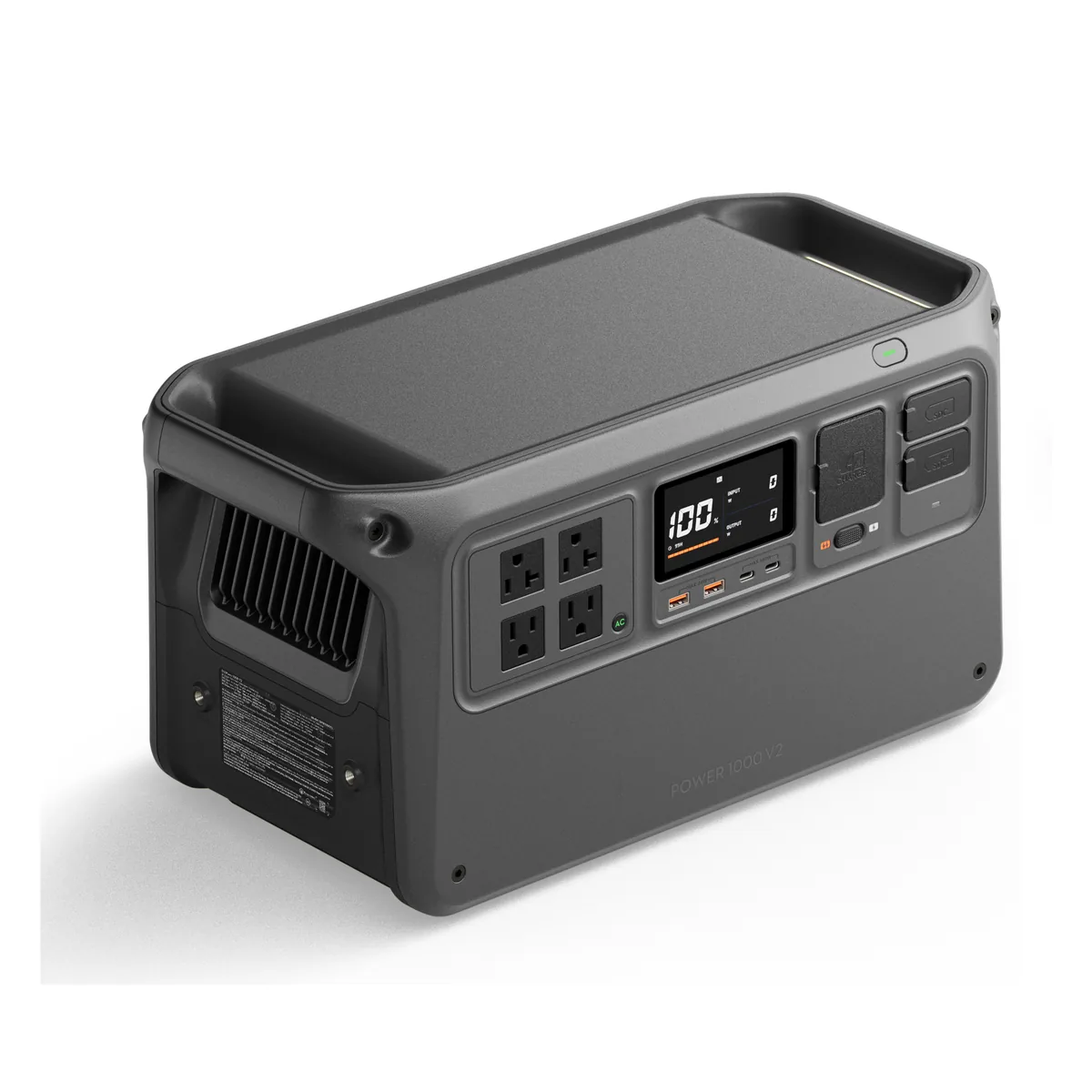
Pick the DJI Power 1000 V2 if
- You run bigger loads: 2600W continuous (DJI’s lab figure at 25°C), against 1800W.
- You may add a lot of battery later: up to 5 Expansion Battery 2000 units, 11,264Wh total, against 2112Wh.
- You want fast USB-C: two 140W ports, 280W combined (PD 3.1 / EPR device and cable needed).
Check the seller, condition and return terms before you buy. DJI’s “up to 5-year” warranty wording applies to purchases from the DJI Official Online Store.
Best for solar and outlets
Pick the Anker SOLIX C1000 if
- You want to plug solar straight in: a built-in 600W input (11–60V, XT-60).
- You want more plugs: 6 AC outlets and a 12V car outlet, against 4 AC and no car outlet.
- You want it lighter, with a flat 5-year warranty: 12.9 kg (28.44 lb) against about 14.2 kg.
This is the original C1000 (A1761), not the C1000 Gen 2. Check the model on the listing before you buy.
Before you buy: the DJI has no built-in solar input or car outlet; solar and fast car charging need DJI accessories sold separately. The Anker can’t charge from AC and solar at the same time (AC takes priority).
As an Amazon Associate I earn from qualifying purchases. The Amazon buttons on this page are affiliate links.
Key specs
spec rows won
spec rows won
unclear
A green check means one figure is clearly better: more than 5% apart, or a feature only one has. No check means it’s within 5%, tied, measured differently or not published. All figures are DJI’s and Anker’s own (US models). The numbers in brackets link to the sources at the bottom of the page.
| DJI Power 1000 V2 | Anker SOLIX C1000 | |
|---|---|---|
| Capacity [1][3] | 1024Wh, LFP | 1056Wh, LiFePO4 |
| Continuous AC [1][3] | 2600W (lab, 25°C) | 1800W, pure sine wave |
| Surge [1][3] | Not published by DJI | 2400W SurgePad (for heat-generating loads) |
| AC outlets [1][3] | 4 | 6 |
| USB-C [1][3] | 2 × 140W, 280W combined (needs PD 3.1 / EPR device and cable) | 1 × 100W, 1 × 30W |
| USB-A [1][3] | 2 ports (watts not confirmed on DJI’s US page) | 2 × 12W |
| 12V DC [1][2][3] | SDC and SDC Lite ports; no car outlet listed | Car outlet, 12V 10A, 120W |
| AC charging [1][3] | 0–80% in 37 min, full in 56 min (lab). Up to 1440W at 60%+ and 20–35°C | Up to 1300W; full in 58 min (HyperFlash, turned on in the app) |
| Solar input [1][3] | None built in. MPPT module (up to 400W) or 1.8 kW Solar/Car charger, sold separately | Built in: 600W max, 11–60V, XT-60 |
| Expansion [1][3] | Up to 5 Expansion Battery 2000, 11,264Wh total | Up to 2112Wh with one expansion battery |
| UPS switchover [1][3] | 0.01 s (10 ms) in UPS mode (lab) | Under 20 ms |
| Weight [1][3] | About 14.2 kg | 12.9 kg (28.44 lb) |
| Cycle life [1][3] | 80% after 4000 cycles (lab) | 80%+ after 3,000 cycles |
| US warranty [1][3] | 3 years, plus 2 more after first connection in the DJI Home app | 5 years |
| Noise [1][3] | As low as 26 dB at 1 m while charging | Not published by Anker |
What it can run
- YES under the AC watts
- TIGHT within 10% of the AC watts
- NO over the AC watts
| Load | DJI Power 1000 V2 (1,024Wh, 2,600W) | Anker SOLIX C1000 (1,056Wh, 1,800W) |
|---|---|---|
| Phone charges, about 15Wh each | YES About 52 charges. | YES About 53 charges. |
| Wi-Fi router, 15W | YES About 52.2 hours. | YES About 53.9 hours. |
| CPAP, 40W | YES About 19.6 hours. | YES About 20.2 hours. |
| Laptop, 60W | YES About 13.1 hours. | YES About 13.5 hours. |
| 50-inch TV, 100W | YES About 7.8 hours. | YES About 8.1 hours. |
| Fridge, 120W average | YES About 6.5 hours. | YES About 6.7 hours. |
| Coffee maker, 1000W | YES About 0.8 hours. | YES About 0.8 hours. |
| Space heater, 1500W | YES About 0.5 hours. | YES About 0.5 hours. |
| Hair dryer, 1800W | YES About 0.4 hours. | TIGHT About 0.4 hours. |
| Several loads at once, 2400W | TIGHT About 0.3 hours. | NO 2,400W is over 1,800W. |
Hours = capacity × 0.85 × 0.90 ÷ load. Estimates, not a test. DJI’s 2,600W is a lab figure at 25°C. Anker’s 2,400W SurgePad isn’t counted as continuous; Anker says it suits heat-generating loads only. Fridges cycle, so the fridge row is rough. Standby draw isn’t published for either unit, so real runtimes on small loads can be shorter.
Skip it if
Skip the DJI Power 1000 V2
if you want to plug solar panels or a 12V car-socket device straight in without buying DJI accessories.
Skip the Anker SOLIX C1000
if you need more than 1800W continuous, or plan to grow past 2112Wh of battery.
Before you buy
- DJI Power 1000 V2: solar and fast car charging need DJI accessories sold separately: the MPPT module (up to 400W), the 1.8 kW Solar/Car Super Fast Charger or the 1 kW Super Fast Car Charger.
- DJI Power 1000 V2: the SDC Lite port is low-power only. The expansion battery and the high-power chargers use the SDC port.
- DJI Power 1000 V2: the 140W USB-C speed needs a device and cable that support PD 3.1 / EPR.
- Anker C1000: its product page title read “Anker SOLIX C1000X” when checked, while its tech-specs block is still headed “C1000 Portable Power Station” and matches the original C1000 (A1761). This page uses that block and doesn’t mix in C1000 Gen 2 figures.
- Anker C1000: Anker’s SurgePad turns on when total output goes over the rated 1800W, up to 2400W. Anker says it’s best for heat-generating devices and doesn’t support precision instruments or devices with strict voltage protection.
- Anker C1000: AC and DC (solar or car) input can’t be used at the same time; AC takes priority. Solar input is 11–32V at 10A max, or 32–60V at 12.5A max, through an XT-60 plug.
- Anker C1000: Anker lists charging at 32–104°F and use (discharge) at –4–104°F, and says it is SGS certified to UL 1012, UL 1778, UL 1973 and UL 60730.
- Warranty: DJI’s US store says 3 years by default, plus 2 more after you download the DJI Home app and complete the first connection. Anker lists a flat 5 years. Check who the Amazon seller is for either one.
Where the sources disagree
- Anker’s product page title read “Anker SOLIX C1000X” when checked, while its tech-specs block is still headed “C1000 Portable Power Station” and matches the original C1000 (A1761). This page uses that block and doesn’t mix in C1000 Gen 2 figures.
- DJI UPS switchover: DJI’s US store FAQ says 0.01 seconds in UPS mode (lab). That’s the same as 10 ms.
- DJI warranty: a footnote on DJI’s store says “up to 5-year warranty” when bought from the DJI Official Online Store. The FAQ says 3 years by default plus 2 after the first DJI Home app connection. This page doesn’t shorten that to a flat 5 years.
- Surge isn’t compared: DJI publishes no surge figure, and Anker’s 2400W SurgePad is a mode for heat-generating loads.
Still Unknown
- DJI dimensions, USB-A watts, SDC and SDC Lite current limits, and operating temperatures: DJI’s official specs page didn’t load, and these weren’t on the US store page or manual.
- DJI surge watts.
- Anker noise, bypass mode and the official in-the-box list: not on the Anker page body checked.
- Standby draw, for both.
As an Amazon Associate I earn from qualifying purchases.
By Mike E. · Last checked November 11, 2026 (DJI figures November 10) · Based on DJI’s and Anker’s official pages and DJI’s manual. Not tested hands-on.
Questions about this pair
What is DJI’s US warranty?
3 years by default, plus 2 more after you download the DJI Home app and complete the first connection. DJI’s “up to 5-year” wording applies to purchases from the DJI Official Online Store. Anker lists 5 years for the C1000. [1][3]
What is Anker’s SurgePad?
It turns on when total output goes over the rated 1800W, up to 2400W. Anker says it’s best for heat-generating devices and doesn’t support precision instruments or devices with strict voltage protection. DJI publishes no surge figure. [3]
How fast does each charge from the wall?
DJI: 0–80% in 37 min and full in 56 min (lab); its 1440W top rate needs the battery at 60% or more and 20–35°C. Anker: up to 1300W, full in 58 min with HyperFlash turned on in the app. The Anker can’t take AC and solar at once; AC takes priority. [1][3]
How far can each expand?
The DJI takes up to five DJI Power Expansion Battery 2000 units, to 11,264Wh. The original C1000 takes one expansion battery, to 2112Wh. [1][3]
Does the DJI have a built-in solar input?
No. Solar and fast car charging need DJI accessories sold separately: the MPPT module (up to 400W), the 1.8 kW Solar/Car Super Fast Charger or the 1 kW Super Fast Car Charger. The Anker has a built-in 600W solar input. [1][3]
Is this the Anker SOLIX C1000 Gen 2?
No. This page compares the original C1000 (A1761). The C1000 Gen 2 is a different model; see Anker SOLIX C1000 Gen 2 vs DJI Power 1000 V2 for that one. [3]
Sources
- [1] DJI Power 1000 V2 US store page, features, FAQ, footnotes and warranty wording
- [2] DJI Power 1000 V2 user manual v1.0, port names
- [3] Anker SOLIX C1000 product page, tech specs block (headed “C1000 Portable Power Station”) and FAQ
Related comparisons
- Anker SOLIX C1000 Gen 2 vs DJI Power 1000 V2
- Anker SOLIX C1000 vs Jackery Explorer 1000 v2
- Anker SOLIX C1000 vs Bluetti AC180
All power station matchups: hadtopick comparisons