The short answer
Overall pick? EcoFlow DELTA 3 Plus
A smaller box with a bit more base battery? Anker SOLIX C1000
Both hold about 1kWh of LFP, with 1800W continuous and 6 AC outlets. The DELTA 3 Plus wins 7 spec rows to 1: more solar (1000W against 600W), faster USB ports, a faster UPS switchover, more rated cycles and room to grow to 5kWh. The original Anker C1000 holds a little more (1056Wh against 1024Wh) in a smaller box, and its 2400W SurgePad helps with heat-generating loads. Both carry a 5-year warranty.
Best all-rounder
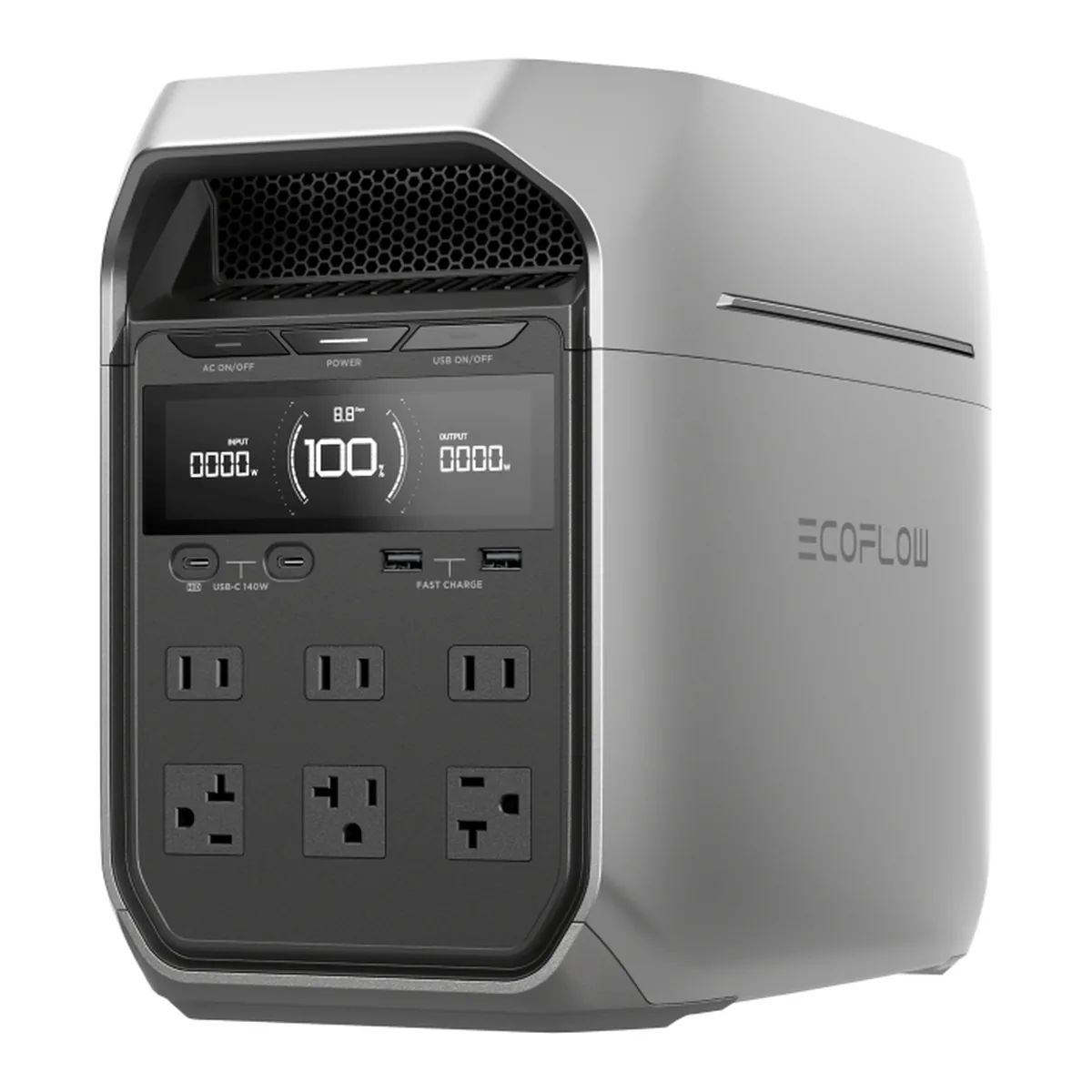
Pick the EcoFlow DELTA 3 Plus if
Full EcoFlow DELTA 3 Plus review
- You want more solar: two built-in inputs, 500W each, 1000W total (full in about 70 min).
- You want room to grow: up to 5kWh with extra batteries, against 2112Wh.
- You back up a PC or NAS: 10 ms switchover and EcoFlow’s Power Manager over USB-C.
Extra batteries are sold separately and connect with the Alternator Charger XT150 Output Cable.
Best for a smaller box
Pick the Anker SOLIX C1000 if
- You want a bit more base battery in a smaller box: 1056Wh in 14.8 × 8.07 × 10.5 in.
- You run heat-generating loads: SurgePad gives up to 2400W when total output goes over 1800W.
- 600W of built-in solar is enough for you.
This is the original C1000 (A1761), not the C1000 Gen 2. Check the model on the listing before you buy.
Before you buy: the Anker can’t charge from AC and solar at the same time (AC takes priority), and its SurgePad isn’t for precision instruments or devices with strict voltage protection. EcoFlow’s X-Boost is off by default and doesn’t work while charging from AC or in bypass.
As an Amazon Associate I earn from qualifying purchases. The Amazon buttons on this page are affiliate links.
Key specs
spec rows won
spec rows won
unclear
A green check means one figure is clearly better: more than 5% apart, or a feature only one has. No check means it’s within 5%, tied, measured differently or not published. All figures are EcoFlow’s and Anker’s own (US models). The numbers in brackets link to the sources at the bottom of the page.
| EcoFlow DELTA 3 Plus | Anker SOLIX C1000 | |
|---|---|---|
| Capacity [2][4] | 1024Wh (51.2V, 20Ah), LFP | 1056Wh, LiFePO4 |
| Continuous AC [1][2][4] | 1800W total, 120V, pure sine wave | 1800W, pure sine wave |
| Surge [1][4] | 3600W | 2400W SurgePad (for heat-generating loads) |
| AC outlets [1][4] | 6 | 6 |
| USB-C [2][4] | 2 × 140W, 280W total | 1 × 100W, 1 × 30W |
| USB-A [2][4] | 2 × 36W, 72W total | 2 × 12W |
| 12V DC [2][4] | Car outlet 12.6V 10A, plus 2 × DC5521; 126W total | Car outlet, 12V 10A, 120W |
| AC charging [1][2][4] | 1500W max; full in 56 min | Up to 1300W; full in 58 min (HyperFlash, turned on in the app) |
| Solar input [1][2][4] | Built in: 2 × XT60, 11–60V, 500W each (1000W total); full in 70 min | Built in: 600W max, 11–60V, XT-60 |
| Expansion [1][2][4] | Up to 5kWh with extra batteries | Up to 2112Wh with one expansion battery |
| UPS switchover [1][2][4] | 10 ms (store page: under 10 ms) | Under 20 ms |
| Weight [2][4] | About 12.5 kg (27.6 lb) | 12.9 kg (28.44 lb) |
| Size [1][2][4] | About 15.7 × 8.0 × 11.2 in (manual; store page about 16 × 8.0 × 11 in) | 14.8 × 8.07 × 10.5 in |
| Cycle life [1][4] | 80%+ after 4000 cycles | 80%+ after 3,000 cycles |
| US warranty [1][3][4] | 5 years | 5 years |
| Noise [1][4] | Under 30 dB at 600W, under 40 dB at 1200W | Not published by Anker |
What it can run
- YES under the AC watts
- TIGHT within 10% of the AC watts
- NO over the AC watts
| Load | DELTA 3 Plus (1,024Wh, 1,800W) | Anker SOLIX C1000 (1,056Wh, 1,800W) |
|---|---|---|
| Phone charges, about 15Wh each | YES About 52 charges. | YES About 53 charges. |
| Wi-Fi router, 15W | YES About 52.2 hours. | YES About 53.9 hours. |
| CPAP, 40W | YES About 19.6 hours. | YES About 20.2 hours. |
| Laptop, 60W | YES About 13.1 hours. | YES About 13.5 hours. |
| 50-inch TV, 100W | YES About 7.8 hours. | YES About 8.1 hours. |
| Fridge, 120W average | YES About 6.5 hours. | YES About 6.7 hours. |
| Coffee maker, 1000W | YES About 0.8 hours. | YES About 0.8 hours. |
| Space heater, 1500W | YES About 0.5 hours. | YES About 0.5 hours. |
| Hair dryer, 1800W | TIGHT About 0.4 hours. | TIGHT About 0.4 hours. |
| Several loads at once, 2400W | NO 2,400W is over 1,800W. | NO 2,400W is over 1,800W. |
Hours = capacity × 0.85 × 0.90 ÷ load. Estimates, not a test. Both are rated 1,800W continuous, so the limits match; the Anker’s 1,056Wh gives slightly longer hours. Surge figures (EcoFlow 3,600W, Anker 2,400W SurgePad) and EcoFlow’s X-Boost aren’t counted as continuous. Fridges cycle, so the fridge row is rough. Standby draw isn’t published for either unit, so real runtimes on small loads can be shorter.
Skip it if
Skip the EcoFlow DELTA 3 Plus
if you want the most battery in the smallest box and 600W of solar is plenty.
Skip the Anker SOLIX C1000
if you want more than 600W of solar, faster USB ports, or plan to grow past 2112Wh of battery.
Before you buy
- DELTA 3 Plus extra batteries: DELTA 3, DELTA Pro 3, DELTA 2 and DELTA 2 Max extra batteries fit, using the Alternator Charger XT150 Output Cable, up to 5kWh.
- DELTA 3 Plus car charging: the car input is 12V, 8A max. EcoFlow’s optional 800W Alternator Charger (via XT150) charges it 0–100% in about 1.3 hours.
- DELTA 3 Plus app: Wi-Fi (2.4 GHz) and Bluetooth, with TOU, Storm Guard, scheduled tasks and Backup Reserve.
- DELTA 3 Plus UPS: EcoFlow calls it a standby UPS with a 10 ms switchover, and lists Power Manager software over USB-C for a PC or NAS.
- Anker C1000: its product page title read “Anker SOLIX C1000X” when checked, while its tech-specs block is still headed “C1000 Portable Power Station” and matches the original C1000 (A1761). This page uses that block and doesn’t mix in C1000 Gen 2 figures.
- Anker C1000: Anker’s SurgePad turns on when total output goes over the rated 1800W, up to 2400W. Anker says it’s best for heat-generating devices and doesn’t support precision instruments or devices with strict voltage protection.
- Anker C1000: AC and DC (solar or car) input can’t be used at the same time; AC takes priority. Solar input is 11–32V at 10A max, or 32–60V at 12.5A max, through an XT-60 plug.
- Warranty: EcoFlow lists 5 years for purchases from EcoFlow or an authorized seller, for US purchase and use. Anker lists 5 years. Check who the Amazon seller is for either one.
Where the sources disagree
- DELTA 3 Plus X-Boost: EcoFlow’s US store spec block lists 2200W, its US manual lists 2600W and the store copy says “over 2600W”. This page doesn’t pick one, and X-Boost isn’t counted in the chart. X-Boost is off by default and doesn’t work while charging from AC or in bypass.
- DELTA 3 Plus size: the US manual lists 202 × 397.6 × 283.6 mm (8.0 × 15.7 × 11.2 in, W × D × H); the store page lists about 398 × 202 × 283.6 mm (16 × 8.0 × 11 in). Same box, rounded and ordered differently.
- Anker’s product page title read “Anker SOLIX C1000X” when checked, while its tech-specs block is still headed “C1000 Portable Power Station” and matches the original C1000 (A1761). This page uses that block and doesn’t mix in C1000 Gen 2 figures.
- Surge is measured differently (EcoFlow’s 3600W surge against Anker’s 2400W SurgePad mode for heat-generating loads), so no check is given.
Still Unknown
- Anker noise, bypass mode, car-charging times and the official in-the-box list: not on the Anker page body checked.
- EcoFlow in-the-box list: not rechecked for this page.
- Standby draw, for both.
As an Amazon Associate I earn from qualifying purchases.
By Mike E. · Last checked November 11, 2026 (EcoFlow figures November 10) · Based on EcoFlow’s and Anker’s official pages, EcoFlow’s manual and warranty policy. Not tested hands-on.
Questions about this pair
How fast does each charge?
DELTA 3 Plus: full in 56 min at 1500W from the wall and about 70 min at 1000W solar (EcoFlow’s internal tests). Anker C1000: up to 1300W, full in 58 min with HyperFlash turned on in the app; solar up to 600W. [1][2][4]
Which extra batteries work, and how far can each grow?
The DELTA 3 Plus takes DELTA 3, DELTA Pro 3, DELTA 2 and DELTA 2 Max extra batteries, up to 5kWh, with the Alternator Charger XT150 Output Cable. The original C1000 takes one expansion battery, to 2112Wh. [1][4]
Can either work as a UPS?
EcoFlow lists a standby UPS with a 10 ms switchover (store page: under 10 ms) and Power Manager software over USB-C for a PC or NAS. Anker lists a switchover under 20 ms. [1][2][4]
What is Anker’s SurgePad?
It turns on when total output goes over the rated 1800W, up to 2400W. Anker says it’s best for heat-generating devices and doesn’t support precision instruments or devices with strict voltage protection. [4]
How quiet is the EcoFlow?
EcoFlow lists under 30 dB at 600W and under 40 dB at 1200W. Anker doesn’t publish a noise figure on the pages checked. [1][4]
Is this the Anker SOLIX C1000 Gen 2?
No. This page compares the original C1000 (A1761). The C1000 Gen 2 is a different model. [4]
Sources
- [1] EcoFlow DELTA 3 Plus US store page, Specs block and product copy
- [2] EcoFlow DELTA 3 Plus user manual (US), spec table and X-Boost figure
- [3] EcoFlow US Limited Warranty policy
- [4] Anker SOLIX C1000 product page, tech specs block (headed “C1000 Portable Power Station”) and FAQ
Related comparisons
- EcoFlow DELTA 3 Plus vs DELTA Pro 3
- Bluetti AC180 vs EcoFlow DELTA 3 Plus
- Anker SOLIX C1000 vs Bluetti AC180
- Anker SOLIX C1000 vs Jackery Explorer 1000 v2
All power station matchups: hadtopick comparisons